


Mobility and Experiences are One Storyline
Travel is not only the movement from one place to another, but comprises the richness of memorable experiences, blending both into a single, seamless journey. A flight is part of a broader itinerary that includes airport transfers, lounge visits, ancillary services, local activities, and digital touchpoints. This continuum requires a loyalty strategy that does not live inside a single application but rather flows across a network of partners. It must integrate with other loyalty programs where it makes sense, and crucially, it must include partners without their own loyalty system so that value and recognition are present at every moment.
Why Travelers Value Seamless Loyalty
Travelers value seamless loyalty for three reasons.
Covenience
Personalization
Emotional Engagement
Recognition moments and well-designed rewards create memories and make customers feel known and valued, not just processed.
The Cost of Fragmented Ecosystems
The Journey as a Stage for Seamless Loyalty
The customer journey provides the natural framework for designing partner-integrated loyalty. Although brief, this chapter anchors the concept.
Partners across the journey
From inspiration and search to post trip advocacy, each stage engages different categories of partners.
- Airlines coordinate with airport services, lounge access, Wi-Fi providers, and ancillary merchants.
- Hotels connect with local attractions, food and beverage partners, and mobility providers.
- Car rental firms align with roadside support, fuel, car services, and insurances.
Some of these partners operate a loyalty program. Many do not.
Partner programs and program partners
Partners with own programs bring existing mechanics and audiences. They may support status recognition, earn and burn, and targeted promotions that require technical and commercial integration.
Partners without a program participate through identity and payment rails, using event-based accrual and offer decisioning at the point of interaction.
Both types must plug into one companion loyalty model.
Payment as a universal touchpoint
Payment is the one touchpoint that consistently shows up across the entire journey. Whether at booking, check-in, at the gate, at the bar, at the charging station, or in a local boutique, payment signals confirm spend and context. That makes co-branded credit cards, digital wallets, and network tokens strategic. Payment is a key enabler of seamless loyalty bridging partners that do not otherwise interoperate and enables automatic earn, real time recognition, and frictionless redemption even where no program is present.
Multi Partner / Multi Program Ecosystem - Opportunities and Tensions
Opening the program to partners with an own independent program expands value but also introduces tensions. While there are advantages in cooperation, there is also competition. This “coopetition” implies a thorough design for cross-program earn and burn without diluting brand equity or breaking economics, in addition to the participation of non-program partners.
Regulatory, Compliance and Fraud Considerations
A multi partner / multi program ecosystem raises the stakes on data protection, cross border compliance, and fraud prevention. Trust is the currency behind the currency.
Data privacy and consent as first principles
Global loyalty programs must comply with privacy laws like GDPR and CCPA, ensuring user consent and data protection at every step. Each partner integration should be designed to respect user preferences, with agreements in place for data processing and international transfers. Using privacy-focused methods – such as pseudonymization and tokenization – helps safeguard personal data throughout the loyalty ecosystem.
Cross border compliance for global travel
Liability, accounting, and consumer protection
Points are financial liability and should be governed with the same discipline as other obligations. Multi partner programs need standardized settlement schedules, clearing rules, and dispute processes that align with consumer protection expectations. Operators should stress test breakage assumptions and simulate shocks to earning or redemption supply to ensure resilience. Clear terms and conditions written in member-friendly language reduce disputes and strengthen trust.
Success Factors and Success Measurement
Partners with established programs need interoperability without surrendering control. The solution is to support multiple modes.
- Mode one is reciprocal earn where members of the airline program earn the airline currency on partner spend while also earning the partner currency through their own enrollment.
- Mode two is currency exchange , where points can be converted under defined rates and caps.
- Mode three is status reciprocity, where tiers map for recognition benefits without currency exchange. The operator should offer policy frameworks and technical templates for each mode that safeguards economics and member clarity.
Payment touchpoints and co-brand cards as enablers
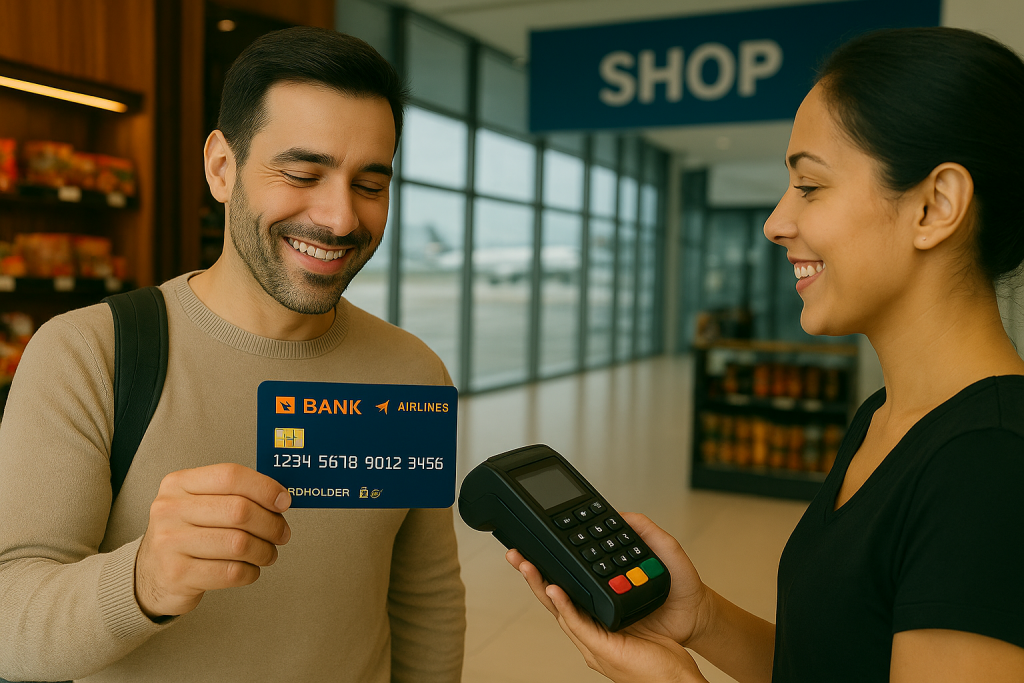
Payment is the most scalable and reliable signal for automatic recognition. Co-branded credit cards provide an even tighter loop since spend data is timely and enriched, and incentives can be managed at the tender level. This enables seamless earn at partners without integration heavy POS changes, using merchant category codes, merchant tokens, and offer IDs to target and measure. On the redemption side, pay with points and statement credit redemption allow members to use value wherever Visa or Mastercard are accepted, subject to policy. This approach respects partner diversity while maintaining a consistent member proposition. The card partner thus becomes a special node in the ecosystem, bridging brands and expanding usable moments without forcing each merchant to build loyalty infrastructure.
KNOWLEDGE HUB
Interested in learning more about how co-branded credit cards drive loyalty in the airline industry?
Explore our in-depth article about Co-Branded Credit Cards for Airlines: A Success Story to be Continued? for practical insights and strategies on leveraging payment partnerships to enhance member engagement and value.
Success measurement should reflect the ambition of an integrated program.
Beyond membership counts, focus on:
- Share of wallet within air, hotel, and ground categories, tracked by segment and tender
- Cross partner engagement such as the number of distinct partners used per trip and the proportion of trips with multi brand earn or burn
- Incremental revenue attributable to offers and benefits, proven through test and control and media mix modeling
- Earn to burn balance and time to first redemption, which correlate with perceived value and retention
- Partner breadth and depth indicating coverage of key moments in the journey rather than raw partner counts
- Unit economics including cost per point issued, redemption cost, and liability health
- Member experience signals such as response time, failure rates on redemption, and satisfaction across touchpoints
The cultural discipline is to publish a single source of truth dashboard shared with partners and to run quarterly trip retrospectives that analyze performance at the journey level, not just by channel.
Conclusion and outlook
The loyalty program that wins in travel is not a card in a wallet. It is a companion that travels with the customer, recognizing them and rewarding them at every relevant moment. To achieve that, brands need a seamless ecosystem for loyalty that integrates partners with their own programs and partners without them, unified by payment as the connective tissue. This approach respects the diversity of travel experiences while ensuring that members feel known and valued throughout.
The road ahead is open and connected
Looking forward, we see open loyalty networks enabling dynamic and ad-hoc partnerships. An airline landing in a new city could automatically light up local offers, benefits, and experiences for arriving members based on consented signals and partner availability. On the next trip, the network could curate a different set of partners aligned with updated preferences and context. Ad-hoc partnerships relate to time-limited events, e.g., for the time of a championship there is an additional set of partners in the ecosystem. The program becomes an orchestrator of value, not merely a ledger of points.
Embedded finance and new forms of value
Embedded finance will accelerate this vision. Buy now pay later can create flexible redemption opportunities such as combining points with installments at checkout. Tokenized balances can support micro redemptions in digital channels without friction. Context aware wallets will allow members to apply the best tender automatically to maximize value without cognitive load. All of these moves expand usable moments and reduce the distance between desire and reward.
A call to action for operators and partners
Now is the time to align on the journey, upgrade the architecture, and formalize partner governance. Start with a compressed scope that proves automatic earn and simple burn across a handful of partners anchored in payment. Measure rigorously. Then expand coverage across more moments and more geographies while keeping an unwavering focus on privacy, security, and unit economics. The outcome is not just a better loyalty program. It is a better way to travel.