
The structure of nearly every airline tiered loyalty program is the same: fly more, earn more, unlock more benefits. Silver to Diamond, the model has been industry standard for decades.
But beneath that familiar framework lies a financial reality most loyalty teams have never fully quantified – and most CFOs have never been shown. The benefits bundled into each tier are not free. They carry real costs, scattered across operations, revenue management, ground handling, and IT. And they are provisioned to every eligible member – regardless of whether that member will ever use them. That gap between what airlines pay for and what members actually value is where the real story begins.
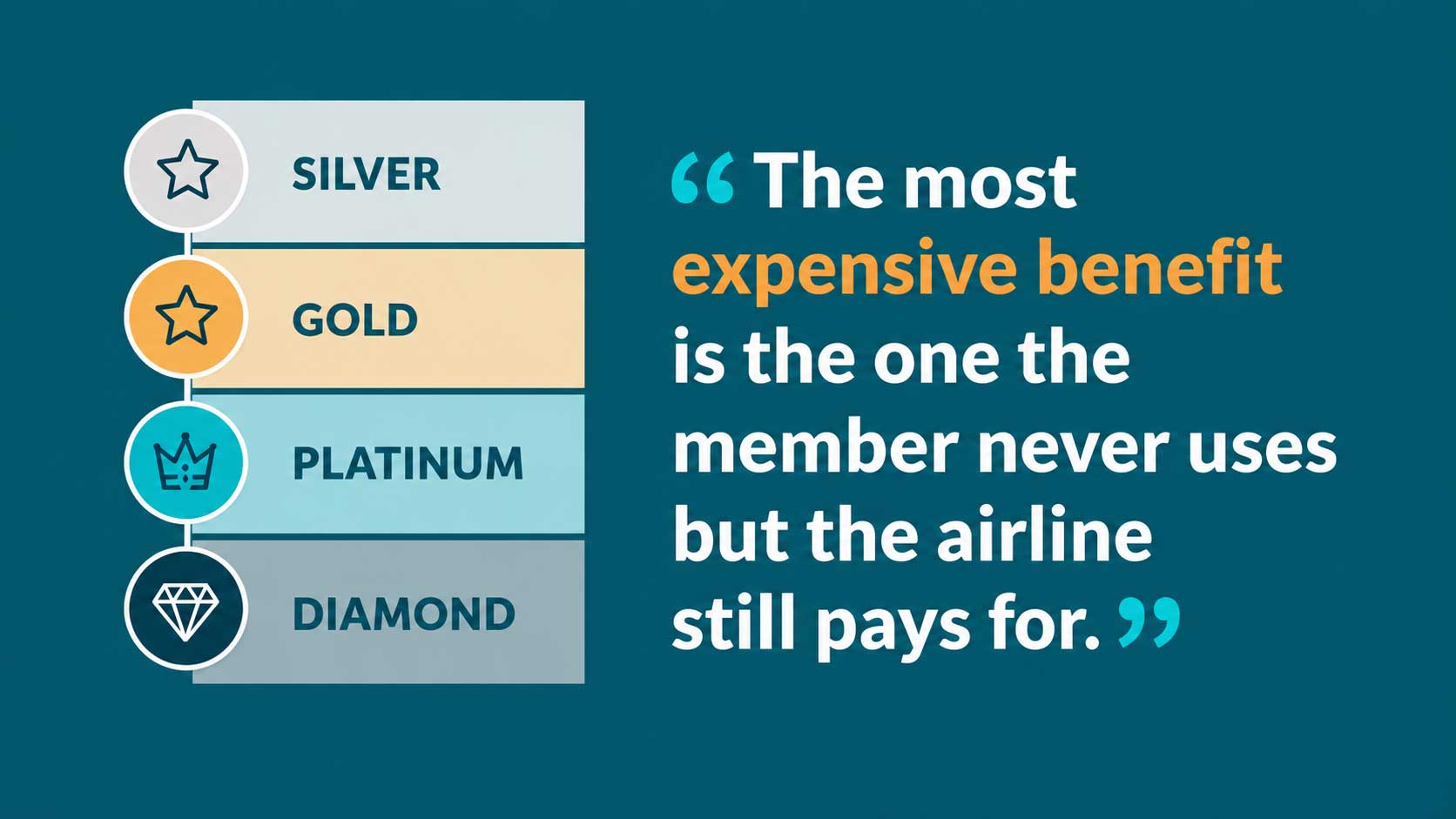
"The most expensive benefit is the one the member never uses – but the airline still pays for"
Explore the full economics in the Airline Tier Benefits Toolkit
Why Tiered Rewards Programs Are More Expensive Than They Appear
- Lounge access sits in catering and real estate budgets.
- Upgrade credits hit revenue management as inventory dilution.
- Bag-fee waivers reduce ancillary revenue in ground handling.
- Status communications and administration run through IT and CRM overhead.
No single team owns the total cost picture. Benefits get added over time – often as competitive responses – without a consolidated view of what each tier actually costs per member per year. And because benefit packages grow disproportionately at higher tiers, loyalty program costs compound in ways the business rarely sees. This is not just a data gap. It is a strategic blind spot – and it becomes even more visible when you look at what members actually do with the benefits they receive.
The Frequent Flyer Benefits Members Never Use
Lounge access – utilization below 50% at mid-tier levels. The majority of entitled members never enter a lounge – yet the program carries the full infrastructure cost.
Status gifting – fewer than 1 in 5 eligible members use it at some tier levels. The airline provisions, communicates, and administers it – absorbing the cost for a benefit most recipients ignore
The pattern is clear: some benefits deliver near-total engagement; others create near-total waste. The program pays for both equally.
But acting on it requires a level of visibility that most programs have not yet built – a clear, quantified view of what each tier truly costs, where value is lost, and how that gap translates into strategic opportunity. Without that foundation, tier benefit redesign remains a conversation without a business case. With it, loyalty leaders and CFOs gain the evidence base to move from assumption to action. That is exactly what the Airline Tier Benefits Toolkit is built to provide.
The Airline Tier Benefits Toolkit
The complete guide to choice-based tier design – built for Heads of Loyalty, Program Directors, and CFOs.
- Full business case for tier benefit redesign
- Industry benchmarks and cost-per-tier analysis
- Three-phase implementation roadmap
- Introduction to the Tier Benefit Economics Calculator
See how leading airlines are redesigning tier benefits.
What Tier Benefit Economics Reveals
Even at a high level, the concept behind the Toolkit is striking. Tier benefit economics is not theory – it is a practical discipline for understanding where loyalty investment delivers return and where it doesn’t.
The approach is straightforward:
Map every benefit to its real cost per tier.
Overlay actual utilization.
Calculate the gap between what the program provisions and what members consume.
That gap is not just inefficiency – it is unrealized potential. Every dollar spent on a benefit a member never uses is a dollar that could fund something they genuinely value.
When programs apply this lens, the findings tend to be uncomfortable. Total tier benefit liabilities are often far larger than leadership assumes, and the share delivering no perceived value is significant enough to reshape the business case for the entire program. The question is not whether the waste exists – it is whether the program has the framework, and the loyalty strategy, to address it and improve loyalty program ROI in the process.
Why Loyalty Design Must Change
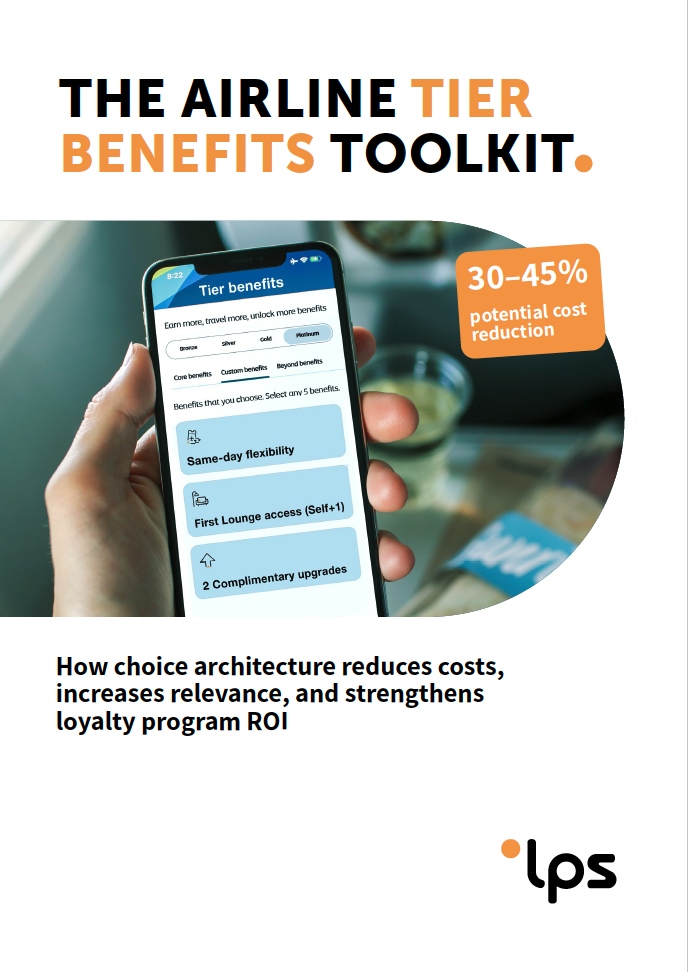
Which is why the industry is already moving. Leading U.S. carriers have introduced choice-based benefit models where members select the perks most relevant to their travel behavior rather than receiving a fixed bundle. The financial logic is powerful: a benefit a member does not select is a cost the program does not incur.
But the value extends beyond cost reduction. When members choose their own benefits, they
- Engage more deeply
- Generate richer behavioraldata
- Perceive their status as personally relevant.
The shift is from entitlement to engagement – from a static loyalty design rooted in volume to a dynamic one rooted in relevance.
For airline loyalty leaders, the signal is clear: the traditional bundled model is reaching its structural limits. Programs that stack benefits without understanding their unit economics and member-level value will face rising costs and declining differentiation.
The alternative is a smarter approach – one that treats tier benefits as a strategic investment, not a fixed entitlement. The Airline Tier Benefits Toolkit explores this shift in full, including how Delta, American Airlines, and United have implemented choice-based models and the economic case behind them.
"Programs that move from bundled provisioning to choice architecture can reduce total tier benefit expenditure by 30–40% - while increasing perceived member value”
Conclusion
At the outset, we posed a simple question: what does your tiered loyalty program actually cost per member? Most programs still cannot answer it with precision. And fewer still have matched that answer against what members actually use.
That gap between provisioning and value is not a minor inefficiency. It is a strategic opportunity – one that the industry’s most forward-thinking programs are already acting on. The future belongs to the tiered loyalty program that treats its benefits as a dynamic portfolio – not a static entitlement schedule. The question is not whether change is needed. It is whether your program has the visibility to know where to start.
For teams ready to put numbers behind the strategy, a focused conversation on your program’s specific economics can be a valuable starting point – we’re happy to think it through with you.