

A five percent increase in customer retention can boost profits by 25 to 95 percent, according to research by Bain & Company. It is one of the most cited statistics in loyalty marketing – and one of the least acted upon where it matters most: in the communication strategy that surrounds a loyalty program before it ever goes live.
Most organizations invest heavily in program mechanics, reward structures, and technology platforms. Communication planning, by contrast, is often treated as a downstream task – something the marketing team will “figure out closer to launch.” That sequencing is the root cause of most retention failures.
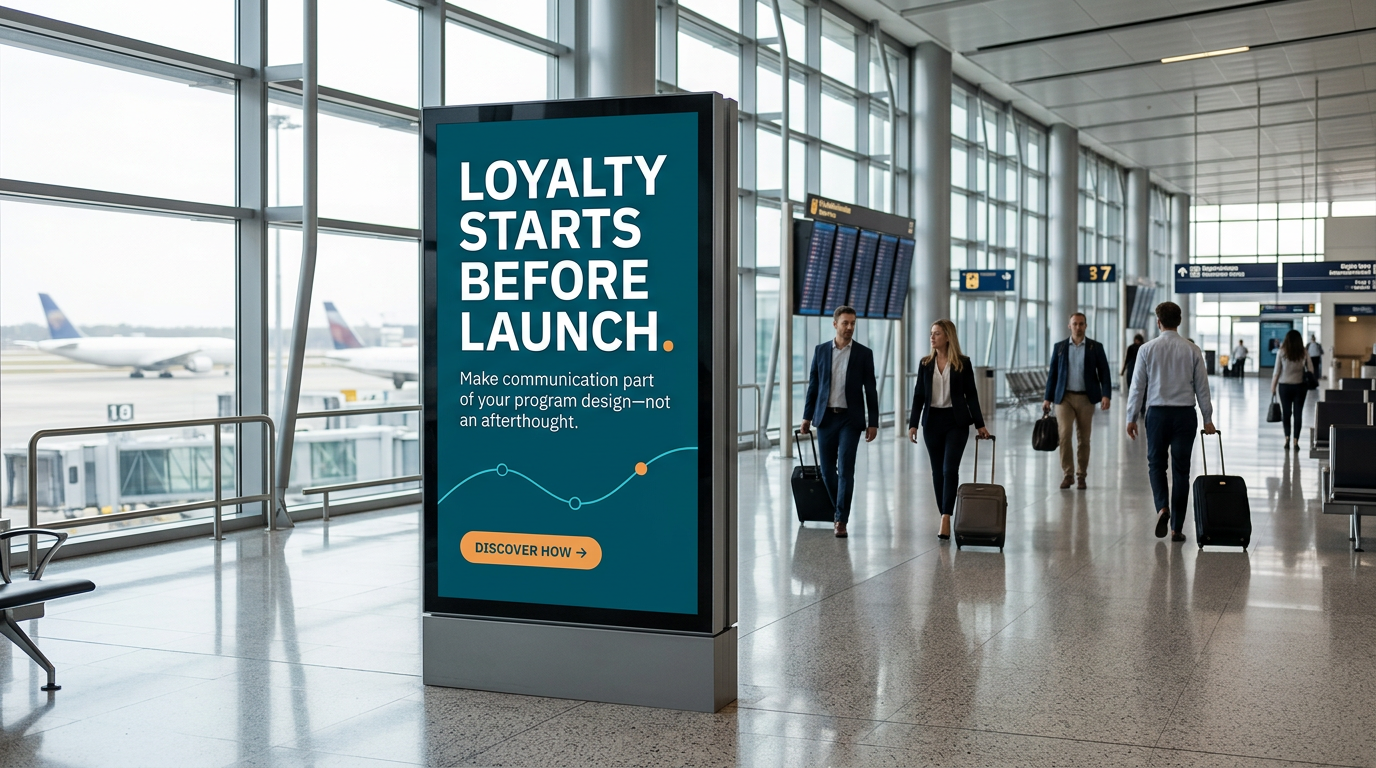
Mechanics and reward logic make a loyalty program possible. Communication makes it effective. It determines how many customers join, how quickly they experience the first value, whether they perceive the rules as fair, and whether they stay. An average program with excellent communication will consistently outperform an excellent program that nobody knows about.
This article explores why customer retention is won or lost in the communication decisions made before launch – and what it takes to get them right.
Why Customer Retention Fails Before Programs Even Launch
The pattern is remarkably consistent. A company spends months designing tier structures, earn-and-burn ratios, and partner integrations. Weeks before launch, someone asks: “What are we telling customers?” By then, the window for strategic communication has already closed.
In a recent program relaunch we supported in the fuel and mobility sector, the client had invested 18 months in program design – but allocated just three weeks to communication planning. Enrollment fell 40 percent below target in the first quarter.
The symptoms are predictable: low enrollment rates despite strong program economics, frontline staff unable to explain the value proposition, partner teams misaligned on messaging, and customers who sign up but never engage. These are not program design failures. They are communication failures – and they are fatal to customer retention.
A loyalty program only exists for the customer once they know about it.
Awareness is not a supporting measure; it is the first conversion stage. Without an understood value proposition, there is no opt-in. Without opt-in, there is no program effect. Customer retention cannot begin if the customer never enters the program in the first place.
This means communication must start well before launch. The less familiar the target audience is with the program and the channels through which it will be delivered, the longer the lead time and the more touchpoints are needed. A single launch email is almost never sufficient. In our experience, brands that begin structured communication 12 or more weeks before launch tend to see materially higher day-one enrollment and stronger early engagement.
As explored in Loyalty Program for Ecommerce: Types, Benefits, and How to Choose the Right Model, the most effective loyalty programs are not defined by their rewards but by how well their design aligns with customer motivations and business objectives. Communication alignment is a design decision – not an afterthought.
Customer retention is decided in the choices made before anyone earns a single point.
The Pre-Launch Communication Framework: Who, What, When
Effective pre-launch communication operates across three dimensions: internal stakeholders, ecosystem partners, and customers. Each requires a distinct approach, timeline, and level of detail.
Internal Stakeholder Alignment
Each internal group has distinct needs:
- Executive sponsors need to understand the strategic rationale.
- Operations and customer service teams need practical training.
- IT needs clarity on data flows and system dependencies. If internal teams cannot articulate the program's value, external communication will be inconsistent at best and contradictory at worst.
Partner and Ecosystem Communication
Co-brand partners, redemption partners, and channel partners all need coordinated briefings. Misaligned partner messaging erodes credibility before customers even enroll.
Customer-Facing Pre-Launch Messaging
This is the layer that demands the most nuance. A practical timeline helps:
- 12 weeks out: Build awareness and set expectations;
- 6 weeks out: Deepen understanding and drive pre-registration
- 2 weeks out: create urgency and confirm readiness.
Beyond target audiences, three cross-functional factors shape communication success: audience differentiation, channel orchestration, and data quality. Together, they ensure communication remains relevant, coordinated, and effective.
Audience Differentiation
Active users, inactive existing customers, and new prospects start with fundamentally different levels of knowledge and intent. The same message sent to all three groups means overwhelm for some and irrelevance for others. Even within a single B2B customer, multiple stakeholders may need different information. Communication must accommodate these differences – not flatten them.
Channel Orchestration
Web, email, personal outreach, and offline touchpoints work best in combination, but they must be coordinated. Duplicate messages delivered through competing systems – say, a sales email and an automated campaign hitting the same contact on the same day – cost credibility. A clear channel ownership matrix, mapping each message type to one primary channel, prevents this.
Data Quality as a Prerequisite
Without current contact data and valid consent, even the best-crafted message fizzles out. Maintaining this foundation is part of the communication strategy, not a precursor to it. Brands should audit contact completeness and consent status at least 16 weeks before launch – before planning what to say, confirm you can actually reach the people who need to hear it.
As Axel Mayer emphasizes in Loyalty Program Design: Building Group-Based Loyalty, clear consent, transparent rules, and fair exit options are essential. Trust is the currency of loyalty, and it must be established before the program goes live.
Setting Customer Expectations: The Psychology of First Impressions
The first messages a customer receives about a loyalty program anchor their perception of its value. That anchor is remarkably persistent – and remarkably difficult to reset if it is set wrong.
Two forces shape this perception: emotional framing and transparency.
Programs that lead with transactional language “earn points, get rewards” position themselves as discount mechanisms. Programs that lead with belonging, recognition, and shared identity create emotional attachment that is far harder for competitors to replicate. As Axel Mayer explains in Social Loyalty Programs: The Psychology Behind Engagement, when group mechanics are introduced, customers stop relating only to the brand and start relating to each other – transforming loyalty from a rational exchange into an emotional bond.
Transparency prevents frustration at the most critical moment.
Conditions, durations, and the timing of point crediting must be understandable before the customer acts. Unclear rules create disappointment exactly when the customer has invested effort – the most expensive possible moment for a trust breach. Every pre-launch message should pass a simple test: can the customer predict what happens after they take the next action? If not, the message has failed.
Communication also makes value visible - and unseen value is no value.
Point balances, achieved milestones, and available benefits only generate retention impact if they are actively reflected back to the customer. This discipline starts before launch: simulators, calculators, or “here’s what you would have earned last month” teasers can make anticipated value tangible before the program is even live.
Customer retention depends on customers believing the program is fair and valuable. That belief is built or broken in the first moments of contact.
Customer Retention from Day One: How Communication Powers the Loyalty Loop
The transition from pre-launch anticipation to post-launch reality is where most programs lose momentum. Strong pre-launch communication raises expectations; what happens in the first 90 days determines whether those expectations translate into lasting customer retention.
Onboarding as a Guided Path
Between registration and first redemption lie the critical drop-off points. Accompanying communication – short explainer sequences, a welcome offer, confirmation of first points earned, a nudge when the redemption threshold is within reach – helps customers cross each hurdle. Think of it as a retention bridge – here is an example: Day 0 (welcome and orientation), Day 3 (first action prompt), Day 14 (first reward visibility), Day 30 (first redemption opportunity). Each touchpoint is a chance to reinforce the decision to join.
Once the onboarding bridge is in place, three communication disciplines sustain the momentum.
Targeted Communication
Segment-based messaging tied to behavior and timing achieves more impact per budget unit than blanket campaigns – and protects against the saturation that drives opt-outs. The audience segments defined during pre-launch planning should carry directly into post-launch targeting. Behavioral triggers – first purchase, point milestone, inactivity threshold – replace calendar-based campaigns with contextually relevant outreach.
Regularity Builds Habit
Loyalty is created through repetition. A reliable communication cadence – biweekly value reminders, monthly account summaries, quarterly milestone reviews – keeps the program present at the decision moment without overwhelming the customer.
Communication as an Early Warning System
Declining activity can be detected through behavioral patterns and addressed with timely outreach. Reactivation before churn is significantly more cost-effective than recovery after. Automated triggers based on inactivity windows – no login in 30 days, no transaction in 60 days – initiate re-engagement sequences that protect customer retention at scale.
As Valentin Avila Rivera writes in Real-Time Data: The New Loyalty Advantage, real-time data infrastructure lets brands recognize the moment of customer intent, interpret it, and act on it. Without that foundation, behavioral triggers and early warning systems cannot function.
And as Axel Mayer notes in Customer Retention Strategies: The ROI of Group-Based Loyalty, even modest improvements in retention generate disproportionate profit impact. The communication disciplines described here are not overhead – they are the highest-leverage investment a program can make.
Pre-Launch Checklist: Building Customer Retention into Every Touchpoint
Strategy is only as strong as its execution. Before launch, validate readiness across six dimensions:
1. Internal readiness audit. Is every customer-facing team – sales, service, retail, digital – briefed on the program’s value proposition and equipped with consistent talking points?
2. Message consistency matrix. Are all channels and partners telling the same story? Map each message to a primary channel owner and verify alignment across all touchpoints.
3. Audience segmentation. Have you defined distinct communication tracks for active customers, inactive customers, new prospects, and internal stakeholders?
4. Customer journey map. Have you mapped the first 30 days from the customer’s perspective – from first awareness through enrollment, first earn, and first
5. Data quality audit. Validate contact completeness, consent status, and segment tagging at least 16 weeks before launch. Without current data and valid permissions, even the best communication strategy cannot reach its audience.
6. Measurement framework. Define success metrics before launch so optimization can begin immediately, not retroactively. Track: message open and click rates by segment, enrollment conversion by channel, 30/60/90-day activation rates, and segment-level engagement variance. Response, conversion, and behavioral change must be systematically captured and fed back into the next communication wave. This is how communication transforms from a cost item into a learning system.
As Jan Ratzlaff explores in Tiered Loyalty Program Benefits: The Cost Nobody Talks About, structural inefficiencies inside loyalty programs are often hidden and rarely discussed. A rigorous pre-launch checklist is where those gaps surface – before they become retention liabilities.
CONCLUSION: LOYALTY STARTS WITH STRATEGY AND GROWS THROUGH ENGAGEMENT.
Customer retention is not a post-launch metric. It is the outcome of every communication decision made before, during, and after a loyalty program goes live.
The brands that treat communication as a strategic design discipline – not a last-minute marketing task – are the ones that see stronger enrollment, faster activation, and more resilient long-term loyalty. Mechanics and reward logic make a loyalty program possible. Communication makes it effective.
Launching or relaunching a loyalty program? Our consulting team helps brands design communication strategies that drive customer retention from day one.
Communication is one of the most overlooked drivers of loyalty program success. But lasting performance depends on more than communication alone. To understand the broader business, customer, and financial factors that determine long-term program success, download our whitepaper Value Drivers of a Loyalty Program.