
Customer loyalty is no longer built over quarters. It is built or eroded in seconds. The gap between what a customer expects and what a loyalty program delivers has narrowed to the length of a single interaction, and the programs that close that gap consistently are the ones rewriting the economics of retention. At the center of that shift sits an increasingly decisive capability: real-time customer data loyalty infrastructure.
This article looks at why batch-based loyalty programs are running out of runway, what “real-time” actually means in a modern loyalty context, where it creates measurable value, and how loyalty leaders can move forward without a disruptive re-platforming.
The moment loyalty is won or lost
Digital-native experiences have fundamentally raised expectations for relevance and personalization. Salesforce’s State of the Connected Customer research shows that customers increasingly expect companies to treat them as individuals rather than transaction numbers. In the latest edition, 73% of customers said companies now do so, while expectations for personalized interactions and seamless experiences continue to rise.
In loyalty, this expectation collides with a structural reality: most programs still operate on data that is hours, often a full day, old. The moment a customer completes a basket, abandons a checkout, downgrades a tier, or contacts service is the moment their next behavior is being decided. If the program cannot recognize and respond to that moment while it is still open, the interaction is effectively lost, regardless of how sophisticated the reporting looks the next morning.
This is the core insight behind modern loyalty design: relevance is a function of timing at least as much as it is a function of segmentation.
Why batch-based loyalty is running out of runway
For most of the past two decades, loyalty programs were built on top of data warehouses optimized for reporting. Overnight ETL jobs consolidated transactions, refreshed segments, and fed campaign tools that dispatched offers in the following cycle. That architecture was fit for purpose in a world where the primary loyalty question was “Who should receive next month’s coupon?”
That world is gone.
The hidden cost of overnight data
Batch pipelines carry an opportunity cost that rarely shows up on a P&L: every triggered moment that could have been acted on – a near-tier-threshold customer, a lapsed high-value member re-engaging, a service failure requiring recovery – is silently absorbed into a report. Gartner and Forrester analyses of customer data platform maturity consistently point to the same pattern: organizations with predominantly batch architectures capture insight but convert only a fraction of it into intervention.
Why dashboards are not decisions
A second, subtler problem is organizational. Batch systems produce dashboards, and dashboards produce meetings. Real-time systems produce decisions, and decisions produce outcomes. In practice, we observe that loyalty teams operating on daily refreshes spend a disproportionate share of their week interpreting yesterday Okay, danke, ich schaue dann weiter – a cadence that is fundamentally misaligned with a customer base whose behavior is continuous.
What real-time customer data loyalty actually looks like
“Real-time” is one of the most abused terms in marketing technology. It is worth being precise.
From data warehouse to event stream
A real-time loyalty foundation shifts the center of gravity from a periodically loaded warehouse to a continuously flowing event stream. Every meaningful customer interaction – a scan, a tap, a page view, a service contact, a partner transaction – is captured as an event the moment it occurs and made available to decisioning systems within seconds, not hours.
Actionable insights vs. reactive reports
The strategic difference is not speed for its own sake. It is the shift from reactive reporting (“what happened?”) to actionable customer insights (“what should happen next, and can we make it happen now?”). This is the practical meaning of event-driven personalization: not more messages, but the right intervention at the moment it still matters.
The role of AI and decisioning layers
On top of the event stream sits a decisioning layer, increasingly AI-supported, that evaluates each event against the customer’s context, program state, and business rules, and selects the next best action (the single most valuable intervention available at that moment, whether an offer, a message, a status update, or no action at all). Machine-learning models improve with every event they observe. Over time, the program stops running campaigns at customers and starts orchestrating experiences with them.
Where real-time creates measurable value
- Contextual offers at the point of intent. Triggered incentives at basket, checkout, or in-store scan convert materially better than scheduled campaigns. McKinsey’s work on personalization has quantified this pattern across sectors, associating advanced personalization with revenue uplifts of 10 to 15 percent and higher marketing efficiency.
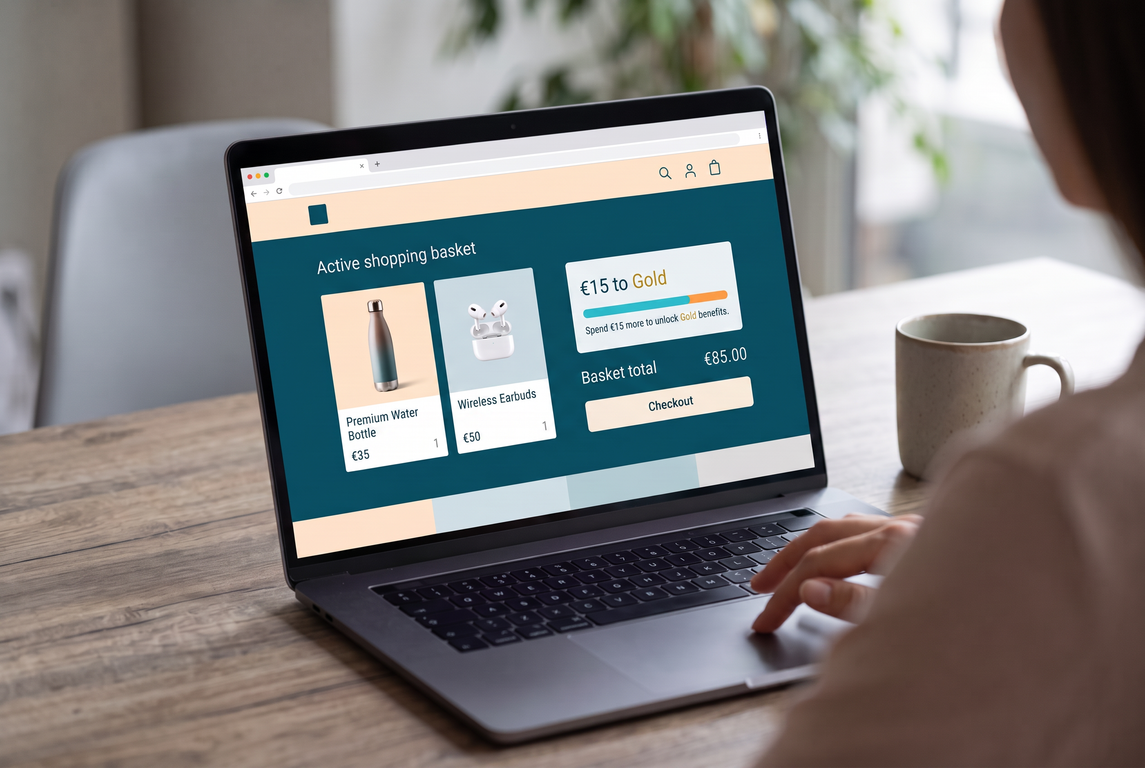
- Dynamic tiering and status recognition. Members approaching a tier threshold behave differently when they know it and when the program acts on it in the moment. Real-time tier logic converts passive status into an active engagement mechanic.
- Service recovery. A negative service event handled within minutes, with a contextually appropriate gesture, has a well-documented outsized effect on retention. Batch systems structurally cannot deliver this.
- Partner activation in coalition programs. In multi-partner ecosystems, real-time data sharing between partners transforms a loosely coupled points scheme into a coordinated engagement engine and materially improves the economics for every participant.
Across these use cases, the pattern is the same: the same customer, the same offer, the same message delivered in the moment produces a different outcome.
The risks nobody talks about
- Data quality. Streaming bad data faster does not improve loyalty; it industrializes noise. Event schemas, identity resolution, and reference data must be disciplined before velocity is added.
- Consent and governance. Real-time decisioning multiplies the number of data points touched per customer per day. Consent management, purpose limitation, and auditability must be engineered in, not retrofitted.
- Organizational readiness. A real-time capability without a team empowered to act on it is an expensive dashboard. Operating models, decision rights, and measurement frameworks need to shift in parallel.
- Measurement discipline. Incrementality, not gross response, is the only honest KPI for real-time interventions. Programs that skip proper test-and-control design tend to overestimate impact and underestimate cost.
An expert observation from work across loyalty modernization programs: the technical build is almost never the constraint. The constraint is the operating model that surrounds it.
A pragmatic roadmap for loyalty leaders
Re-platforming a loyalty program in a single move is rarely the right answer. A use-case-led path is faster, cheaper, and materially less risky:
Prioritize the moments.
Identify two or three high-value moments where timing changes the outcome – typically basket completion, tier-threshold behavior, service recovery, or reactivation of a lapsed high-value segment.
Instrument the events.
Industrialize decisioning.
Measure incremental lift, then scale.
Conclusion: from data-rich to decision-rich
Most loyalty programs are already data-rich. The competitive question for the next few years is not who collects the most data, but who converts it into decisions fast enough to shape the customer’s next move. Real-time infrastructure is the mechanism that makes that possible and the leaders who treat it as a strategic capability rather than a technical upgrade will define the next generation of loyalty economics. The starting point is not a bigger platform. It is a shorter list of moments that matter, instrumented properly, and acted on now. For most organizations, the fastest way in is the roadmap above: pick two moments where timing changes the outcome, instrument them cleanly, and let measured lift, not ambition, pace the rollout. The programs that make that shift first will not just personalize better; they will operate on a different clock than their competitors.
Explore how LPS helps loyalty leaders turn real-time customer data into measurable business impact – talk to our loyalty experts or discover more insights in our Knowledge Hub.